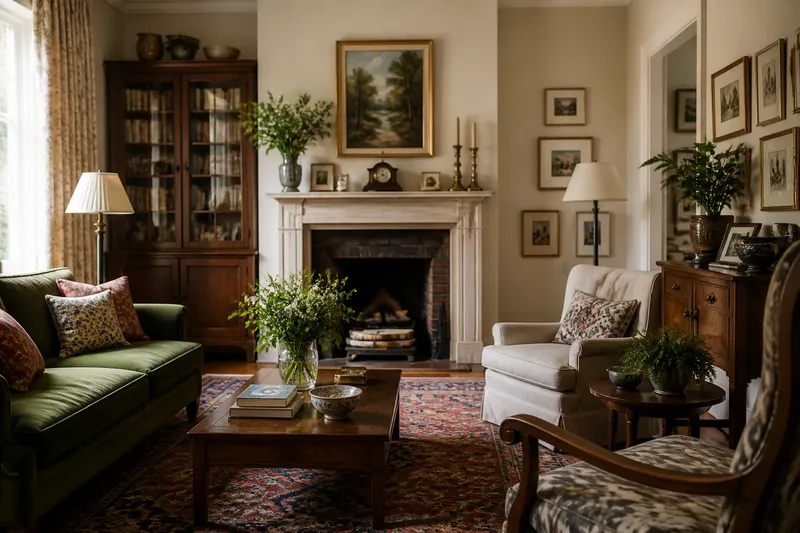
Why Repeated Shapes Make a Shelf Feel Ordered
Repeated shapes make a shelf feel ordered by giving the eye a clear rhythm; learn how to vary spacing so the arrangement stays composed, not mechanical.
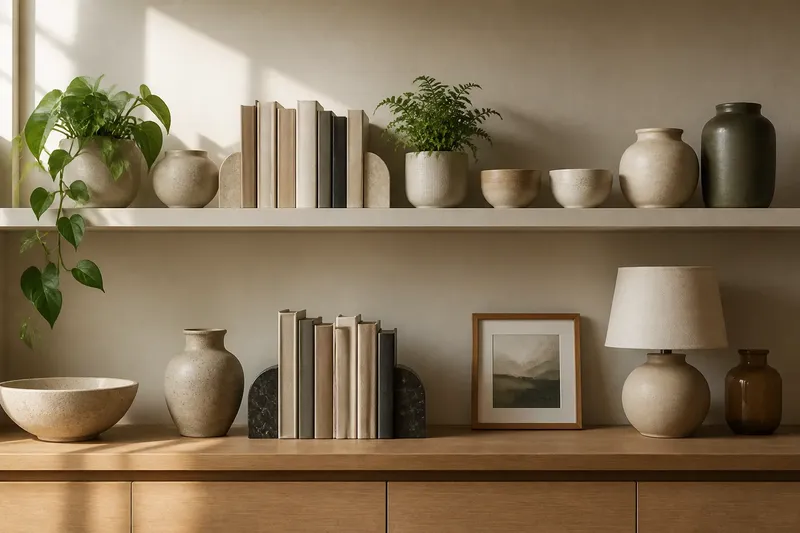
Repeated shapes make a shelf feel ordered because the eye can recognise a pattern without inspecting every object separately. A row of similarly sized bowls, bookends or storage boxes gives the gaze a dependable beat; small changes in spacing can make that beat feel considered rather than rigid.
This effect is a matter of form, not simply matching colours or buying a set. Repetition links objects through a visible feature, while spacing determines how strongly the link is felt. Once you see those two parts working together, you can arrange what you already own with more intention.
Repetition gives the eye a pattern to follow
A repeated shape might be a circle, a rectangle, a tall narrow silhouette or a curve repeated across several objects. The items need not be identical. A group of cylindrical jars and rounded cups can still share a family resemblance, even if their materials and uses differ.
When shapes recur, the eye learns what to expect. It moves from one object to the next and notices the group as a whole, rather than treating every piece as an unrelated event. This is visual rhythm: a sequence of forms and intervals that guides attention across a surface.
Think of a row of chairs along a wall. Similar backs create a steady pattern, but a chair turned slightly or set apart can change the pace. On a shelf, the same principle applies at a smaller scale. The repeated outline provides continuity; the spaces between objects provide pauses.
Choose a shape family before arranging objects
Begin by deciding what feature will repeat. It may be the upright line of book spines, the circular mouth of ceramic vessels, or the rectangular front of labelled boxes. A clear shared feature makes an arrangement legible, even when the objects differ in colour or size.
It helps to distinguish a shape from a silhouette. Shape describes a form such as a circle or rectangle. A silhouette is the outline an object presents from the front. A stack of books and a small framed print are different objects, but both may contribute a broad rectangular outline when viewed from across the room.
Look at the shelf from the position where you usually see it, rather than judging each item in your hands. A curved handle may disappear from that angle, while the height of a vase becomes prominent. The useful repeated feature is the one the viewer can actually recognise.
- For a strong, quiet rhythm: repeat one obvious outline, such as a run of book spines or a few round vessels.
- For a looser rhythm: repeat a family of related forms, such as rounded bowls alongside a rounded lamp base.
- For a mixed collection: use one recurring shape among varied objects, so the shared outline ties the group together without making every item match.
Do not force a shape family where none is visible. If the objects have competing outlines, a repeated colour or material may be more apparent than form. For this arrangement, however, keep the question focused: what shape can a viewer pick out more than once?
Spacing controls the pace of the arrangement
Objects that sit close together tend to read as a cluster. Wider gaps separate them and can make each one seem more independent. Neither choice is automatically better: the useful spacing depends on whether you want the repeated forms to feel like one group or a sequence of individual pieces.
Even spacing is easy to read, but it can make a shelf feel mechanical when every object has the same outline and sits at the same interval. A slight change creates a pause or a quicker passage. The shape still repeats, while the eye has a reason to notice the arrangement rather than merely count its units.
Imagine you have four small, rounded planters on a long shelf. You place two close together, leave a more generous gap, then set the remaining pair nearer each other. From the doorway, the repeated curves still connect the planters, while the larger pause gives the group a distinct centre and makes the row feel less like a production line.
That adjustment need not be dramatic. Move one item by a small amount, then step back and see whether the pause is visible from your usual viewing position. If it disappears at a distance, it may be too slight to affect the rhythm; if it breaks the group apart, reduce the gap.
An everyday analogy is a row of words on a page: regular spaces make reading possible, while a paragraph break marks a larger pause. Shelf spacing works in a similar way. A small interval links neighbouring objects; a larger interval can signal a new cluster.
Use variation without losing the repeated form
Spacing is only one way to soften repetition. Objects can vary in height, orientation or visual weight while retaining a recognisable shape family. A low bowl beside a taller rounded vessel, for instance, keeps the curve in view but changes the skyline of the arrangement.
Vary one feature at a time when the pattern feels too uniform. If you alter spacing, height and orientation all at once, it becomes harder to tell which change is helping. A measured adjustment makes the relationship between the forms easier to judge.
Consider the shelf’s outer edges as well as the objects. If the repeated forms fill the entire length at the same interval, the pattern may seem to continue beyond the shelf. A clear gap at one end, or a separate object that interrupts the run, can give the sequence a beginning or an ending.
There is also a difference between a useful interruption and an accidental distraction. A contrasting object can serve as a visual pause if it sits where the rhythm needs relief. If it is much larger or has a very different outline, it may become the main event instead. Decide whether that is what you want before adding it.
How can you tell whether the rhythm is working?
Do repeated objects need to be identical?
No. They need a feature that remains recognisable across the group, such as a shared outline or proportion. Differences in finish, use or height can add interest while the recurring shape holds the arrangement together.
How much spacing variation is enough?
Enough for the pause to register from the normal viewing position, but not so much that the repeated objects stop reading as a group. Make one modest change, step back, and adjust according to what you can actually see.
Can books create a repeated shape?
Yes. Their spines form a sequence of narrow rectangles, especially when they stand upright together. A shorter stack can change the rhythm without losing the rectangular form, though a shelf filled with varied book heights may produce a less regular outline.
What if the shelf still looks crowded?
Repetition cannot make every arrangement feel spacious. Remove an object or separate the group if the repeated outlines overlap visually and the gaps no longer read as pauses. Keeping fewer forms can make the remaining pattern easier to follow.
Read the shelf from a distance before refining it
From close up, small differences in glaze, grain or detail can dominate. From farther away, the broad outlines and gaps become clearer. Check both views: the close view tells you whether the objects sit comfortably together, while the distant view shows whether the repeated form actually produces a readable rhythm.
Try looking at the shelf from its main approach, then from an angle if people commonly pass it from the side. A form that appears repeated head-on may be hidden behind another object from a different position. Shift the arrangement only where that change improves the view that matters to you.
When you want to make a shelf feel ordered, start with one visible shape family and let the spacing do some of the work. Repeated shapes create the pattern; a small, deliberate pause keeps it from feeling mechanical. The result can be orderly without making every object behave like part of a matched set.